Tesla Stock Predictions: Robotaxi & 2026 Targets

AI forecast
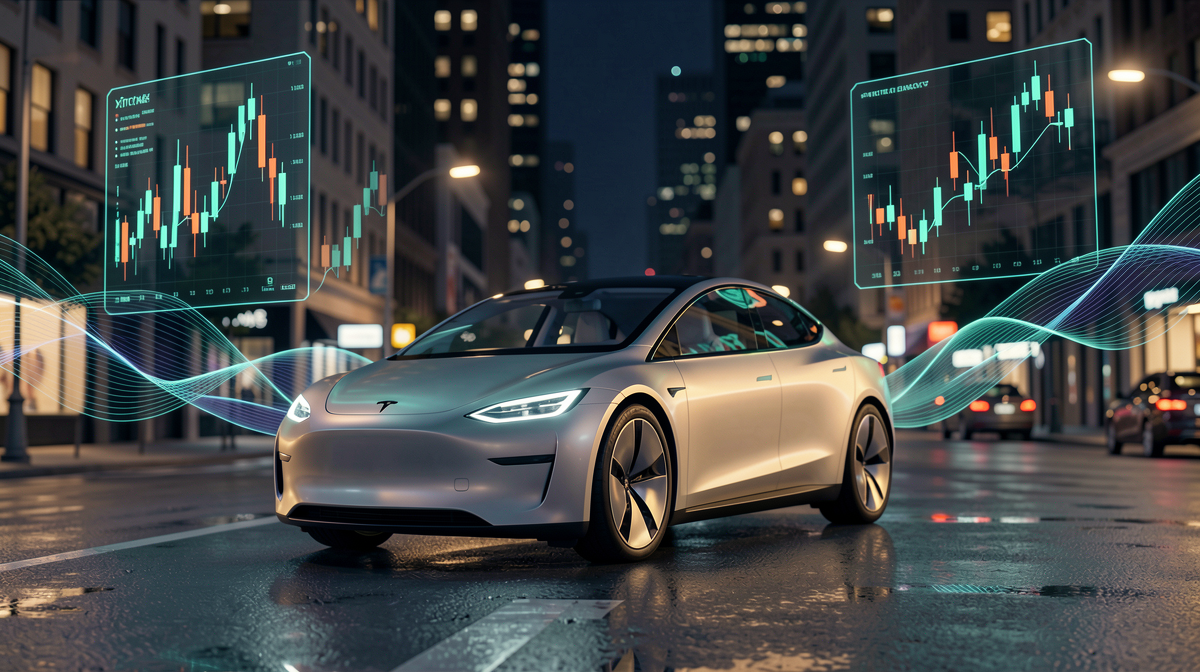
The 2026 bull case for Tesla rests less on EV deliveries and more on the execution of its Robotaxi network. We break down the specific catalysts and risks driving Tesla stock predictions.
- Robotaxi deployment speed is the primary variable for 2026 upside, not EV volume.
- Regulatory approval in key states remains the largest hurdle for the autonomy thesis.
- AI-driven traffic optimization could unlock new software revenue streams independent of car sales.
- Our internal AI forecasts for TSLA are experimental and currently lag simple baseline models.
The Shift from Hardware to Autonomy
For years, Tesla stock predictions centered on production targets, battery costs, and quarterly EV delivery numbers. That framework is becoming obsolete. The market now prices TSLA primarily as an artificial intelligence and robotics company. The 2026 bull case depends almost entirely on the successful commercialization of the Robotaxi network, a pivot that decouples the stock’s trajectory from broader consumer automotive trends.
Investors are no longer asking how many Model 3s shipped in Q3. They are asking if Tesla can safely deploy unsupervised autonomous driving at scale. The difference is critical. Hardware margins are compressing across the industry. Software and autonomy services, if executed correctly, offer higher margin potential and recurring revenue. This article examines the specific catalysts that could drive a Tesla stock forecast 2026 rally, and the risks that could stall it.
Robotaxi Deployment as the Core Catalyst
The Robotaxi thesis is not about self-driving cars in the traditional sense. It is about a network effect. Tesla’s strategy relies on its existing fleet of customer vehicles eventually contributing data and, potentially, revenue. The specific catalysts to watch are not vague promises but concrete milestones: regulatory approval in California and Texas, the launch of a dedicated ride-hailing app, and the release of a purpose-built vehicle like the Cybercab.
Without these three elements, the stock trades on traditional automotive multiples. With them, the narrative shifts to software-as-a-service. The 2026 timeline is aggressive. It requires Tesla to solve edge-case driving scenarios that have stumped competitors for a decade.
- Regulatory Green Lights: State-level approval for unsupervised operations is the gatekeeper. Without it, the Robotaxi remains a feature, not a business unit.
- Fleet Utilization Rates: The economic model depends on high utilization. If autonomous cars sit idle, the revenue per vehicle collapses.
- Cost per Mile: Tesla must demonstrate that autonomous operation is cheaper than human-driven alternatives like Uber or Lyft.
The 2026 and 2027 Forecast Framework
A Tesla stock forecast 2026 cannot rely on a single number. It must be scenario-based. The bear case assumes regulatory delays push the Robotaxi launch into 2028, forcing the stock to compete solely on EV pricing. In this scenario, TSLA faces margin pressure from Chinese competitors and slowing global EV demand.
The base case assumes a phased rollout. Tesla launches in limited geographies with human safety monitors, generating revenue but not full autonomy profits. This supports the stock but limits upside. The bull case, which drives the high-end Tesla stock price prediction, assumes Tesla achieves Level 4 autonomy in key markets by late 2026. This would validate the data moat and open up massive licensing or fleet partnership opportunities.
Why AI Traffic Optimization Matters
Beyond the Robotaxi itself, Tesla’s AI stack has secondary applications. Traffic optimization and energy grid balancing are adjacent markets. If Tesla’s neural nets can predict traffic patterns accurately enough to manage a ride-hailing fleet, that same technology could be sold to municipalities or logistics companies. This diversifies revenue away from pure car sales.
Risks to the Autonomy Thesis
The biggest risk is not competition. It is execution. Tesla’s Full Self-Driving (FSD) software has faced scrutiny for years. Any major safety incident involving an unsupervised Robotaxi could freeze regulatory progress for months. Public trust is fragile. One headline about an accident can undo a quarter of good news.
There is also the risk of capital intensity. Building a Robotaxi fleet requires massive investment in compute infrastructure. NVIDIA (NVDA) and other chipmakers have seen valuations soar on AI demand. Tesla must manage its own capital expenditure carefully. If the return on AI investment lags, the balance sheet could suffer, pressuring the stock even if the technology works.
Beyond the EV Sales Cycle
Traditional automotive metrics are losing relevance for TSLA. Gross margin on cars is important, but software gross margin is the new focus. Investors should watch for disclosures on FSD attach rates and, crucially, the percentage of revenue derived from non-hardware sources.
If Tesla reports that software and services account for a significant portion of gross profit by 2026, the stock will re-rate. If it remains a hardware company with software add-ons, it will trade at a discount to high-growth tech peers. The gap between a $200 stock and a $400 stock in 2026 likely hinges on this single metric: the credibility of the autonomy revenue stream.
How Our AI Forecasts View TSLA
We use an experimental AI model to generate stock predictions for the companies we cover, including TSLA. It is vital to state plainly that these AI forecasts are experimental and, in our internal checks, were no better than a simple "no change" guess. They are not reliable predictors of price movement.
However, the model highlights volatility patterns. It flags when TSLA’s price action decouples from the S&P 500 or the Nasdaq. This suggests the market is reacting to company-specific news—like Robotaxi updates—rather than macroeconomic trends. Use the AI data as a sentiment gauge, not a trading signal.
What to Watch in Late 2025 and 2026
The path to a bullish Tesla stock forecast 2027 is paved with near-term regulatory wins. Keep an eye on NHTSA investigations and state DMV approvals. These are leading indicators. Also, monitor the adoption rate of the Cybercab. If production numbers are low or delivery times stretch, the fleet economics weaken.
Finally, watch the competitive response. Waymo is already operating in several cities. If Waymo expands aggressively and captures the regulatory and public trust ground first, Tesla’s window for dominance narrows. The Robotaxi race is a sprint, not a marathon.
Frequently asked questions
What is the main catalyst for Tesla stock in 2026?
The primary catalyst is the successful commercial rollout of the Robotaxi network. Investors are focused less on EV delivery numbers and more on whether Tesla can achieve unsupervised autonomous driving at scale, which would transform the company's revenue model from hardware to high-margin software and services.
How does the Robotaxi narrative affect Tesla stock predictions?
The Robotaxi narrative shifts valuation multiples from traditional automotive levels to tech and AI software levels. If Tesla proves it can generate revenue from autonomous fleets, analysts may raise price targets significantly. If rollout delays occur, the stock may trade on weaker EV margins alone.
Is Tesla's AI stock forecast reliable?
No. Our internal AI forecasts for TSLA are experimental and, in historical checks, performed no better than a simple "no change" guess. They are useful for observing market sentiment and volatility patterns but should not be relied upon as accurate price predictors.
What are the biggest risks to the 2026 Tesla stock forecast?
The biggest risks are regulatory delays in key states like California and Texas, potential safety incidents that halt public trust, and failure to achieve high utilization rates in the Robotaxi fleet. Competition from established players like Waymo also poses a significant threat to market share.
Please note. AI Stock Predictions content is generated by artificial-intelligence and machine-learning models for educational and informational purposes only. It is NOT financial, investment or trading advice. Forecasts can be wrong. Always do your own research and consult a licensed financial advisor before making investment decisions. Investing involves risk, including possible loss of principal. Our AI forecasts are experimental: in our own checks they were no better than a simple “no change” guess.
Securities in this article
- TSLA Tesla Motors · Smart Score 2/10 · Valuation
Smart Score, valuation and dividends in AI-Stock Invest: rules-based descriptions, the same for every reader — information, not advice.