Tesla Stock Forecast 2026: Robotaxi & Hardware Cycle

AI forecast

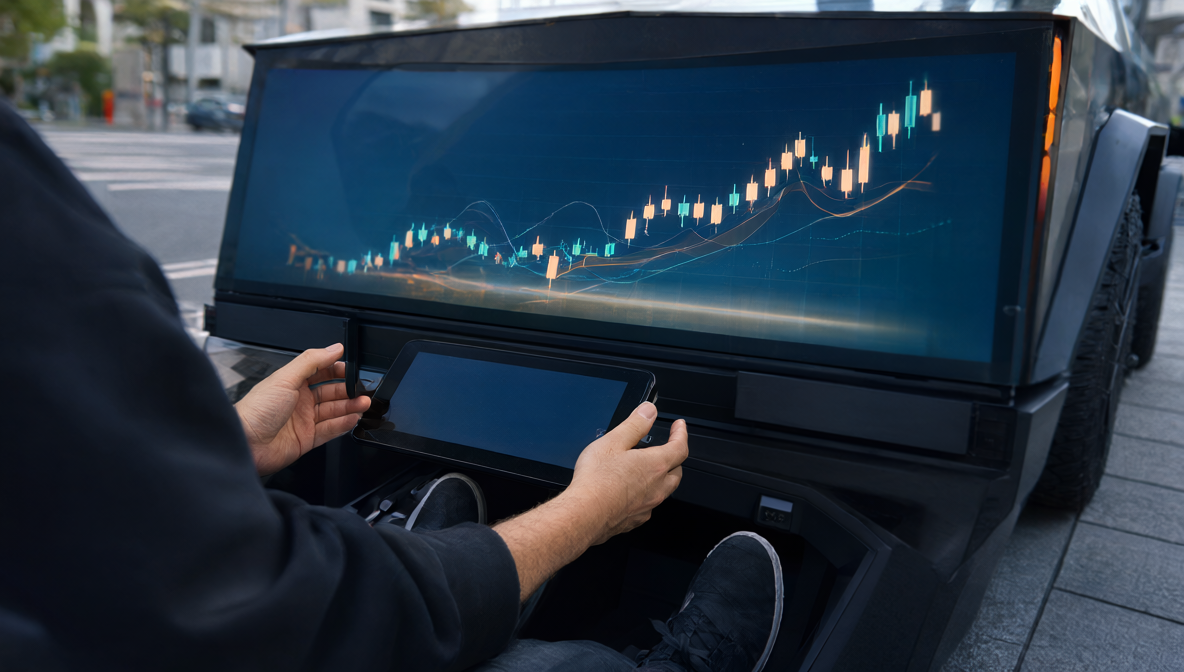
As Tesla moves past its initial hardware saturation, the 2026 investment thesis hinges on the successful scaling of its robotaxi network. This analysis breaks down how software margins and hardware refresh cycles will drive valuation through the mid-decade.
- Tesla's valuation increasingly decouples from pure vehicle volume, tying closely to software attach rates and robotaxi density.
- The 2026 hardware cycle focuses on cost reduction via the next-gen platform, prioritizing margins over raw unit growth.
- Broader market volatility, evidenced by recent Treasury yield surges, creates short-term noise but does not alter Tesla's long-term structural advantages.
The Shift to Software-Led Valuation
The conversation around Tesla stock forecast 2026 has shifted decisively from unit delivery counts to profitability per vehicle. Investors are no longer asking how many cars TSLA sells, but how much recurring revenue each car generates through Full Self-Driving (FSD) subscriptions and the emerging robotaxi network. This transition is critical because hardware manufacturing is cyclical and margin-constrained, whereas software services offer scalable, high-margin income streams that justify premium valuations. By 2026, the expectation is that Tesla will have successfully pivoted its core identity from an automaker to an AI-driven transportation service provider.
The robotaxi rollout timeline is the single biggest variable in this equation. If Tesla achieves critical density in major metropolitan areas by mid-decade, the company unlocks a network effect that traditional automakers cannot replicate. This does not just mean selling more cars; it means monetizing the idle hours of existing fleets. The margin expansion potential here is significant, as software updates and autonomous driving capabilities become the primary differentiators against competitors like BYD and legacy OEMs who are still struggling to balance EV costs with profitability.
Tickers in focus
| Ticker | Company | Sector | Exchange |
|---|---|---|---|
| 1 | CK Hutchison Holdings | other | unknown |
| 101 | Hang Lung | real_estate | unknown |
| 1024 | Kuaishou Technology | telecom | unknown |
| 1038 | CK Infrastructure Holdings | utilities | unknown |
| 1044 | Hengan Group | consumer | unknown |
| 1055 | China Southern Airlines | industrials | unknown |
| 1061 | Essex Bio-Technology | health_care | unknown |
| 1066 | Shandong Weigao Group Medical Polymer | health_care | unknown |
| 1088 | China Shenhua Energy | energy | unknown |
| 1093 | CSPC Pharmaceutical | health_care | unknown |
| 1099 | Sinopharm Group | health_care | unknown |
| 1109 | China Resources Land | real_estate | unknown |
| 1113 | CK Asset Holdings | real_estate | unknown |
| 1171 | Yankuang Energy Group | energy | unknown |
| 1177 | Sino Biopharmaceutical | health_care | unknown |
| 12 | Henderson Land | real_estate | unknown |
Tools the pros use to research stocks — See recommended tools ›
Hardware Cycle and Margin Dynamics
While software captures the narrative, the hardware cycle remains the foundation of Tesla’s cash flow. The next-generation platform, slated for widespread impact around 2026, aims to drastically reduce component count and assembly time. This is not merely about making a cheaper car; it is about optimizing the balance sheet. By simplifying the manufacturing process, Tesla can maintain healthy gross margins even if average selling prices (ASP) decline due to competitive pressures. This hardware efficiency provides the necessary cushion to invest heavily in the AI infrastructure required for autonomous driving.
Investors should watch the interplay between hardware refresh cycles and software adoption rates. A faster hardware cycle allows Tesla to push new features to a larger base of eligible vehicles more quickly, accelerating the software revenue flywheel. Conversely, if hardware updates stall, the perceived value of the software ecosystem may diminish. The 2026 forecast assumes a steady cadence of iterative improvements that keep the product lineup fresh without cannibalizing existing inventory, a delicate balance that Tesla has managed relatively well in recent years.
Market Context and Macro Headwinds
No stock exists in a vacuum, and the broader market environment plays a crucial role in near-term price action. Recent trends show significant volatility in equity markets, with indices like the Dow and S&P 500 experiencing sharp swings driven by Treasury yield fluctuations. For instance, news headlines from late September 2026 noted that the Dow jumped more than 470 points on Friday despite Treasury yield surges, illustrating how macro factors can override fundamental company news in the short term. Tesla, with its high beta characteristics, often amplifies these market moves.
However, these macro headwinds also present opportunities. When bond yields rise, defensive sectors often attract capital, but growth-oriented tech stocks like Tesla can see increased volatility. The key for investors is to distinguish between noise and signal. While the broader market might be "shrugging off bond sell-offs" as seen in recent weekly gains, Tesla’s specific drivers—robotaxi adoption and hardware efficiency—remain tied to company-specific execution rather than just interest rate sensitivity. The divergence between Tesla’s stock performance and the general market suggests that its valuation is increasingly driven by its unique AI and autonomy story rather than general consumer discretionary trends.
Analyzing Peer and Sector Performance
To contextualize Tesla’s position, it is helpful to look at the broader sector dynamics captured in our platform data. While Tesla operates in the global EV space, comparisons with Asian tech and industrial giants offer insights into regional demand and tech adoption rates. For example, Kuaishou Technology (1024) and Hua Hong Semiconductor (1347) reflect the health of the digital infrastructure and chip supply chains that underpin autonomous vehicles. Strong performance in these ancillary sectors often correlates with increased demand for smart vehicle features.
Similarly, looking at consumer and industrial stocks like Hengan Group (1044) and China Southern Airlines (1055) provides a gauge on consumer spending power and logistics efficiency, both of which impact Tesla’s delivery timelines and service network utilization. If consumer confidence in major markets holds up, as suggested by resilient performance in sectors like financials (AIA Group, 1299) and industrials, Tesla’s premium pricing model remains sustainable. These cross-sector indicators help validate whether the demand for premium EVs and autonomous services is broadening beyond early adopters to the mainstream.
Robotaxi Economics and Network Density
The economic case for the robotaxi rests on utilization rates. A privately owned car sits idle for roughly 95% of its life. A robotaxi, theoretically, operates near continuously. For Tesla, this means the hardware cost is amortized over significantly more miles, lowering the cost per mile for the end user. By 2026, the goal is to have a dense enough network in key hubs (like Austin, California, and select international cities) to make waiting times negligible. This density is what transforms the service from a novelty into a utility.
The impact on margins is two-fold. First, high utilization spreads fixed costs over more revenue units. Second, it creates a data feedback loop. More miles driven by autonomous fleets generate more training data for the neural nets, which improves the software, which attracts more users. This virtuous cycle is difficult for competitors to break once established. Investors should monitor the ratio of active fleet miles to total fleet size as a leading indicator of network health. If utilization climbs steadily, the margin expansion thesis holds water. If it stalls, the capital-intensive nature of the fleet could weigh on free cash flow.
Risks and Competitive Landscape
Despite the bullish case, risks remain. Competition from Chinese EV makers is intensifying, with companies like BYD offering competitive hardware at aggressive price points. While Tesla’s software advantage is a moat, hardware parity is closing. Additionally, regulatory hurdles in various jurisdictions could slow the rollout of autonomous features. The 2026 forecast assumes that Tesla can maintain its lead in data processing and AI integration, but this is not guaranteed. The company must continuously innovate to stay ahead of well-funded rivals who are eager to capture the autonomous driving market share.
Another consideration is the dilution effect of new models. As Tesla expands its lineup to cover more segments, it risks confusing its brand identity. The next-gen platform must deliver a cohesive experience that reinforces the premium tech positioning. If the hardware cycle fails to deliver noticeable improvements in range, charging speed, or autonomy, the software premium may erode. Therefore, the success of the 2026 thesis relies on tight integration between hardware improvements and software capabilities, ensuring that each new model reinforces the value proposition of the ecosystem.
Investment Strategy for the Mid-Decade Horizon
For investors looking at the Tesla stock forecast 2026, the strategy should focus on resilience and execution. Short-term volatility driven by macro factors like Treasury yields should be viewed as entry opportunities if fundamentals remain intact. The focus should remain on the transition metrics: software attach rates, fleet utilization, and margin stability. These are the levers that will drive the stock’s performance through the rest of the decade. A diversified approach that considers Tesla alongside complementary tech and industrial stocks can help mitigate single-stock risk while capturing the upside of the autonomous revolution.
Note: Predictions and analysis provided here are generated by AI models and are based on available data and historical trends. They are not guaranteed and should not be considered financial advice. Always conduct your own research before making investment decisions.
Frequently asked questions
What is the main driver of Tesla stock growth in 2026?
The primary driver is expected to be the expansion of the robotaxi network and increased software attach rates, which offer higher margins than traditional hardware sales. This shift moves the valuation focus from unit volume to recurring service revenue.
How does the hardware cycle affect Tesla's profit margins?
The next-generation hardware platform aims to reduce manufacturing complexity and costs, allowing Tesla to maintain healthy gross margins even if vehicle prices face competitive pressure. This efficiency supports reinvestment in autonomous driving technology.
Why are Treasury yields important for Tesla stock analysis?
Rising Treasury yields can increase borrowing costs and impact the valuation of growth stocks like Tesla by raising the discount rate for future cash flows. However, Tesla's specific AI-driven growth story often helps it maintain relevance despite broader macro volatility.
Is the robotaxi rollout guaranteed to succeed by 2026?
While progress is being made, the rollout depends on regulatory approvals and technical reliability. Success hinges on achieving sufficient network density in major cities to make the service convenient and economically viable for widespread adoption.
Please note. AI Stock Predictions content is generated by artificial-intelligence and machine-learning models for educational and informational purposes only. It is NOT financial, investment or trading advice. Forecasts can be wrong. Always do your own research and consult a licensed financial advisor before making investment decisions. Investing involves risk, including possible loss of principal.