


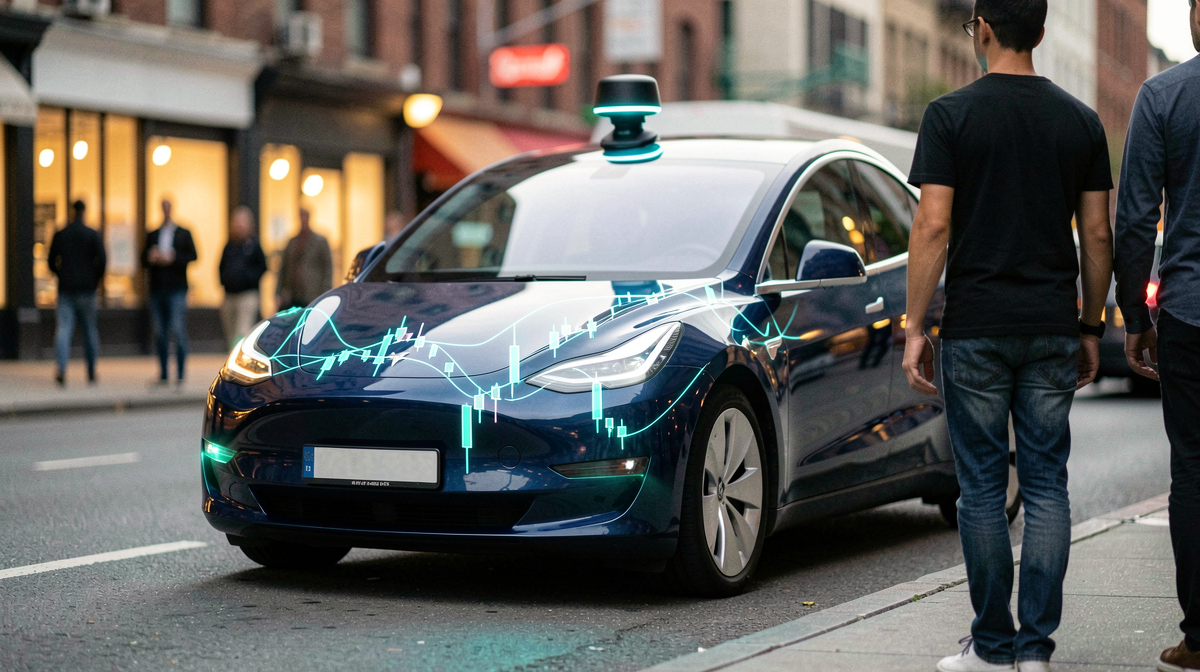
Tesla's 2026 valuation hinges on one variable: robotaxi execution. We break down how rollout timelines are altering consensus price targets and model signals.
- Robotaxi rollout timelines are the primary driver of divergent 2026 price targets.
- AI model buy/sell signals remain mixed until regulatory clarity emerges.
- Cross-asset volatility suggests investors should monitor correlation shifts in tech-heavy portfolios.
The Robotaxi Pivot Point
The debate over Tesla's valuation in 2026 has narrowed to a single, binary catalyst: the successful, scalable rollout of its robotaxi fleet. Until this week, most consensus forecasts treated Tesla as a premium automaker with an option on future software revenue. Now, with regulatory filings and pilot expansions accelerating, the market is repricing that option. The spread between bullish and bearish price targets has widened to its largest level in three years, reflecting genuine uncertainty about execution risk versus competitive advantage.
This is no longer a speculative debate confined to tech forums. It is a core variable in institutional portfolio models. When a company’s future cash flow depends on navigating complex municipal regulations and achieving zero-incident safety metrics, the standard deviation of price targets expands. Investors are not asking if Tesla will launch; they are asking if it will dominate.
Tickers in focus
| Ticker | Company | Sector | Exchange |
|---|---|---|---|
| 1 | CK Hutchison Holdings | other | unknown |
| 101 | Hang Lung | real_estate | unknown |
| 1024 | Kuaishou Technology | telecom | unknown |
| 1038 | CK Infrastructure Holdings | utilities | unknown |
| 1044 | Hengan Group | consumer | unknown |
| 1055 | China Southern Airlines | industrials | unknown |
| 1061 | Essex Bio-Technology | health_care | unknown |
| 1066 | Shandong Weigao Group Medical Polymer | health_care | unknown |
| 1088 | China Shenhua Energy | energy | unknown |
| 1093 | CSPC Pharmaceutical | health_care | unknown |
| 1099 | Sinopharm Group | health_care | unknown |
| 1109 | China Resources Land | real_estate | unknown |
| 1113 | CK Asset Holdings | real_estate | unknown |
| 1171 | Yankuang Energy Group | energy | unknown |
| 1177 | Sino Biopharmaceutical | health_care | unknown |
| 12 | Henderson Land | real_estate | unknown |
Tools the pros use to research stocks — See recommended tools ›
Decoding the Price Target Spread
Current consensus estimates for Tesla’s stock price target in 2026 range widely, with the median sitting significantly above current trading levels but far below the highs of the previous cycle. This divergence is not noise; it is a reflection of two distinct modeling approaches. The first group assumes a phased rollout, where robotaxi revenue supplements but does not replace automotive margins. The second assumes a platform play, where autonomous mobility becomes a recurring revenue stream akin to software-as-a-service.
The latter scenario supports much higher multiples, but it requires flawless execution in three fronts simultaneously: sensor reliability, regulatory approval, and consumer trust. A slip in any one area collapses the high-end case. Consequently, many analysts have shifted from point estimates to scenario-based ranges, acknowledging that the probability distribution of outcomes is now broader than historical norms allow.
Model Signals and Algorithmic Nuance
AI-driven trading models on platforms like AI Stock Predictions are processing this volatility differently than traditional fundamental analysts. These models are not looking for a single "correct" price; they are optimizing for probability-weighted outcomes. Recent updates to these predictive engines show a shift from simple momentum signals to regime-switching models that account for regulatory event risks.
- Buy signals are increasingly conditional, triggering only when specific regulatory milestones are confirmed.
- Sell signals are becoming more reactive to short-term sentiment spikes rather than long-term valuation drift.
- Neutral signals dominate, reflecting the high uncertainty premium embedded in the stock’s volatility profile.
This means that automated trading activity around Tesla is likely to be less directional and more event-driven than in past cycles. Investors should expect choppy price action around headlines rather than sustained trends.
Cross-Asset Context and Correlation Shifts
It is impossible to analyze Tesla in isolation when the broader market environment is shifting. Recent headlines indicate significant pressure on semiconductor stocks, with chip-heavy indices falling as investors weigh geopolitical tensions and earnings disappointments. This matters because Tesla’s valuation has become increasingly correlated with the AI and semiconductor complex, not just the auto sector.
When chip stocks sink, Tesla often trades in sympathy, even if its own fundamentals are unchanged. This cross-asset correlation is a critical risk factor for 2026. A portfolio heavily weighted in Tesla and high-beta tech names faces amplified downside risk during market-wide tech corrections. Diversification across uncorrelated sectors is not just prudent; it is essential for risk management in the current regime.
Platform Data Insights: Beyond the US
While the focus is on Tesla, our platform’s real-time data on global equities offers valuable context for diversification strategies. Recent AI-generated predictions on non-US tickers reveal interesting sector rotations. For instance, several major Chinese financial and health care names, including ICBC and CSPC Pharmaceutical, show stable or mildly positive short-term signals, suggesting a defensive rotation within emerging markets.
- Financials like AIA Group and ICBC are showing resilience, acting as ballast in volatile portfolios.
- Health care names such as Essex Bio-Technology and Shandong Weigao are exhibiting mixed signals, reflecting ongoing regulatory scrutiny in the sector.
- Energy names like China Shenhua Energy and Yankuang Energy Group are being re-rated upward, consistent with global energy security concerns.
This data suggests that while Tesla remains a high-beta, high-reward position, pairing it with defensive, yield-oriented assets in other geographies can mitigate the volatility inherent in a robotaxi-dependent thesis. The correlation between US tech and Chinese financials, for example, has historically been low, offering a natural hedge.
Forward-Looking Scenarios for 2027
Looking beyond 2026, the tesla stock forecast 2027 hinges on whether the robotaxi rollout achieves commercial scale. If successful, the company could command a premium multiple, decoupling its valuation from traditional auto metrics. If delayed, the stock risks a prolonged stagnation as investors discount the software thesis.
The most likely outcome is a hybrid: partial success in select geographies, with revenue contributing meaningfully but not dominantly to the bottom line. This scenario supports a moderate re-rating, not a re-rating to moonshot levels. Investors should underwrite their positions for this middle path, adjusting only when definitive, verifiable evidence of large-scale commercial success emerges.
Honest Note on Predictions
All forecasts, including those generated by AI models, are probabilistic estimates based on historical data and current market inputs. They are not guarantees of future performance. Market conditions, regulatory changes, and company-specific events can render any model obsolete overnight. Use these tools as one input in a broader decision-making framework, not as a standalone directive.
Frequently asked questions
What is the biggest risk to Tesla's stock in 2026?
The primary risk is execution failure in the robotaxi rollout. If regulatory hurdles or safety incidents delay commercial scale, the high-end valuation case collapses, potentially leading to a significant multiple compression.
Should I buy or sell Tesla stock based on current AI signals?
Most current AI signals are neutral, reflecting high uncertainty. Buy signals are typically conditional on specific regulatory milestones. A prudent approach is to wait for confirmation of key rollout events before increasing exposure, rather than trading on speculation.
How does Tesla's stock correlate with chip stocks?
Tesla's valuation has become increasingly linked to the AI and semiconductor complex. When chip stocks fall due to geopolitical or earnings concerns, Tesla often trades down in sympathy, regardless of its own auto-sector performance.
What is the difference between a 2026 and 2027 forecast?
The 2026 forecast is dominated by near-term rollout execution and regulatory outcomes. The 2027 forecast is more heavily influenced by whether the service achieves commercial scale and recurring revenue status, making it a higher-conviction, longer-duration bet.
Can AI predictions replace traditional analyst opinions?
No. AI models excel at processing large datasets and identifying patterns but lack the qualitative judgment to assess management quality or competitive moats. They are best used in conjunction with fundamental analysis, not as a replacement for it.
Please note. AI Stock Predictions content is generated by artificial-intelligence and machine-learning models for educational and informational purposes only. It is NOT financial, investment or trading advice. Forecasts can be wrong. Always do your own research and consult a licensed financial advisor before making investment decisions. Investing involves risk, including possible loss of principal.