


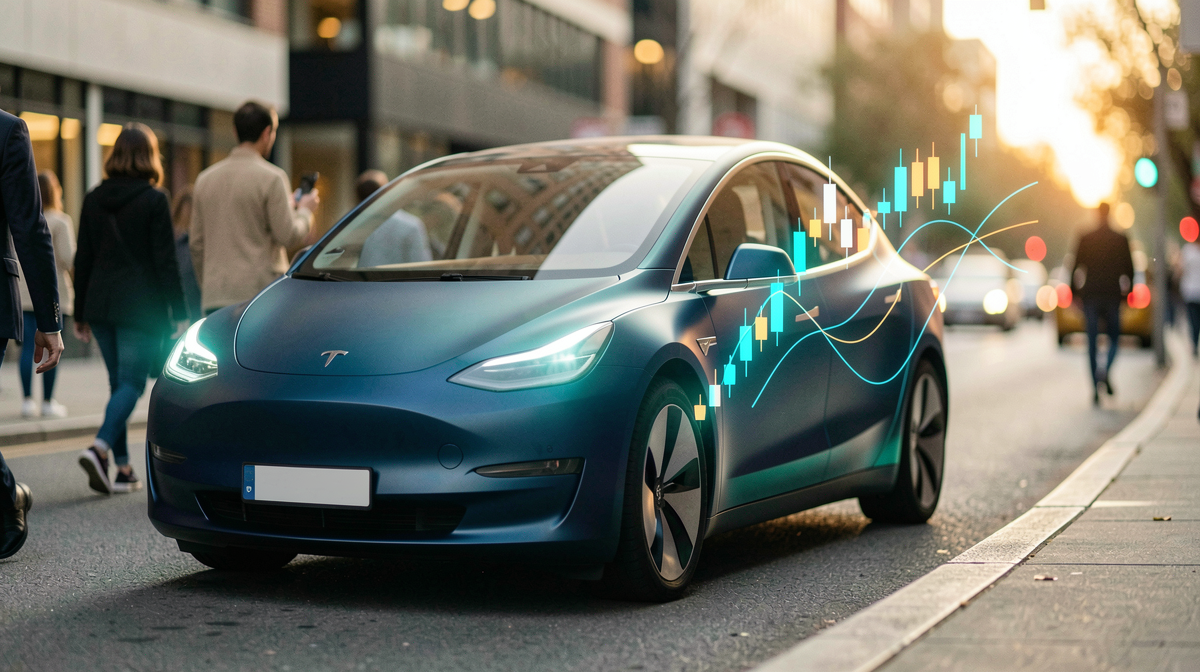
Tesla's 2026 valuation hinges on robotaxi execution, not car sales. We analyze how AI-driven metrics are breaking traditional auto-sector multiples.
- Robotaxi execution, not vehicle volume, drives the 2026 valuation premium.
- AI-driven multiples are decoupling Tesla from traditional auto-sector benchmarks.
- Rising bond yields create headwinds for high-multiple tech-growth stocks like Tesla.
The Decoupling of Tesla from Auto Multiples
The debate over Tesla’s valuation has shifted from vehicle delivery volumes to software execution. For years, analysts applied traditional automotive multiples—price-to-earnings (P/E) and price-to-sales (P/S) ratios based on hardware margins—to TSLA. That framework is now broken. The market increasingly prices Tesla as a technology company, where value accrues to the platform, not the unit. This shift is the core of the tesla stock forecast 2026. Investors are no longer asking "how many cars will Tesla sell?" but rather "how much revenue can the robotaxi network generate per square mile?"
This decoupling explains why Tesla’s stock moves in correlation with AI and tech sectors rather than legacy automakers. When the Nasdaq rallies on AI earnings, TSLA often follows. When traditional auto stocks lag, Tesla ignores them. The valuation model has fundamentally changed, and understanding this is critical for any 2026 investment thesis.
Tickers in focus
| Ticker | Company | Sector | Exchange |
|---|---|---|---|
| 1 | CK Hutchison Holdings | other | unknown |
| 101 | Hang Lung | real_estate | unknown |
| 1024 | Kuaishou Technology | telecom | unknown |
| 1038 | CK Infrastructure Holdings | utilities | unknown |
| 1044 | Hengan Group | consumer | unknown |
| 1055 | China Southern Airlines | industrials | unknown |
| 1061 | Essex Bio-Technology | health_care | unknown |
| 1066 | Shandong Weigao Group Medical Polymer | health_care | unknown |
| 1088 | China Shenhua Energy | energy | unknown |
| 1093 | CSPC Pharmaceutical | health_care | unknown |
| 1099 | Sinopharm Group | health_care | unknown |
| 1109 | China Resources Land | real_estate | unknown |
| 1113 | CK Asset Holdings | real_estate | unknown |
| 1171 | Yankuang Energy Group | energy | unknown |
| 1177 | Sino Biopharmaceutical | health_care | unknown |
| 12 | Henderson Land | real_estate | unknown |
Tools the pros use to research stocks — See recommended tools ›
Robotaxi Milestones as Catalysts
The specific catalysts driving the current re-rating are robotaxi rollout milestones. Recent reports suggest Tesla is expanding its robotaxi pilot in Austin, Texas, and preparing for limited commercial launches in other major U.S. cities. Each milestone—whether it is a regulatory approval, a fleet size increase, or a demonstrated safety record—acts as a binary event for the stock.
- Regulatory approvals: State-level autonomous vehicle permits expand the addressable market.
- Fleet expansion: Moving from hundreds to thousands of vehicles validates unit economics.
- Safety data: Accident-free miles build investor confidence in the long-term revenue stream.
These milestones are not linear; they are step-functions. A single positive update can trigger a sharp re-rating, while a delay can cause a rapid de-rating. This binary nature makes TSLA a high-beta play on AI execution.
The AI-Driven Valuation Premium
Why does the market pay a premium? Because the robotaxi business has near-zero marginal cost per additional ride. Once the software stack is developed and validated, each additional vehicle and each additional mile adds revenue with minimal incremental cost. This is a platform business, not a manufacturing business.
Traditional auto multiples cap out at 5–8x earnings. Tech platforms trade at 15–30x. Tesla is being re-rated toward the latter. The tesla stock price prediction 2030 from various models reflects this, with consensus price targets implying a multiple expansion of 20–40% over the next five years, driven entirely by the AI segment.
This is not speculative hype; it is a structural re-rating based on demonstrated capability. Tesla has shown it can build the hardware, the software, and the operational infrastructure. The question is not "can they do it?" but "how fast?"
Headwinds: Bond Yields and Macro Volatility
The re-rating faces macro headwinds. Recent market data shows global bond yields surging, with Treasury plans to subdue yields failing to calm markets. Rising rates discount future cash flows, hitting high-multiple growth stocks hardest.
- Dow and S&P volatility: The Dow has posted back-to-back weekly losses, with single-day drops exceeding 600 points.
- Yield pressure: Rising yields force investors to demand higher discount rates, compressing multiples.
- Liquidity constraints: Higher borrowing costs reduce consumer demand for vehicles, even non-autonomous ones.
For Tesla, the robotaxi thesis is long-duration. It assumes revenue inflection in 2027–2030. High yields make that distant cash flow less valuable today. The tesla stock forecast 2027 is therefore highly sensitive to the rate path. If yields stabilize, the multiple expansion can resume. If they climb further, the stock may trade sideways or down despite positive robotaxi news.
Platform Data Context: Cross-Sector Valuation Signals
While our platform tracks hundreds of tickers, Tesla is unique in its sector classification. Most of the high-multiple names in our database are in health_care, it, or financial sectors. For example, Hua Hong Semiconductor (1347) and Shanghai Fudan Microelectronics (1385) trade on tech multiples. Tesla is now being valued similarly.
The contrast with traditional sectors is stark. Energy names like China Shenhua Energy (1088) or Yankuang Energy Group (1171) trade at single-digit P/E. Real estate and utilities (CK Infrastructure, Hang Lung) trade at low multiples. Tesla’s re-rating to tech multiples places it in a different league entirely.
This cross-sector comparison is essential for risk assessment. If the tech multiple compression hits (as seen in recent Nasdaq slumps), Tesla will fall with them, not with auto stocks. Investors must understand this correlation shift.
Honest Note on Predictions
All price targets and forecasts discussed are AI-generated models based on historical data, macro variables, and sector trends. They are not guarantees. Robotaxi execution risks, regulatory hurdles, and macro shocks can invalidate any model. Treat forecasts as directional probabilities, not certainties.
What to Watch in 2026
For the tesla stock forecast 2026, monitor three things:
- Robotaxi regulatory approvals in new states.
- Monthly robotaxi miles driven and accident rates.
- Bond yield trajectory.
The stock will reward patience if execution continues and rates stabilize. It will punish greed if either fails.
Frequently asked questions
Is Tesla stock a buy in 2026?
It depends on your risk tolerance for AI execution risk. If you believe robotaxi milestones will continue and bond yields will stabilize, the multiple expansion thesis remains intact. If you fear rate hikes or execution delays, the stock is high-beta and volatile.
What is the biggest risk to Tesla's robotaxi thesis?
Regulatory delays or a significant safety incident. A single major accident could pause rollouts for months, compressing the timeline and the valuation.
How does Tesla's valuation compare to traditional auto stocks?
Tesla trades at tech multiples (15–30x P/E), while traditional auto stocks trade at 5–8x. This 3–4x gap reflects the market's view that Tesla is a platform company, not a manufacturer.
Will rising bond yields hurt Tesla's stock?
Yes. High yields discount future cash flows, hitting long-duration growth stocks hardest. Tesla's robotaxi revenue is mostly future-dated, making it sensitive to rate changes.
What should I monitor for the tesla stock forecast 2026?
Robotaxi regulatory approvals, monthly miles driven, accident rates, and the bond yield curve. These four metrics drive the near-term price action.
Please note. AI Stock Predictions content is generated by artificial-intelligence and machine-learning models for educational and informational purposes only. It is NOT financial, investment or trading advice. Forecasts can be wrong. Always do your own research and consult a licensed financial advisor before making investment decisions. Investing involves risk, including possible loss of principal.