


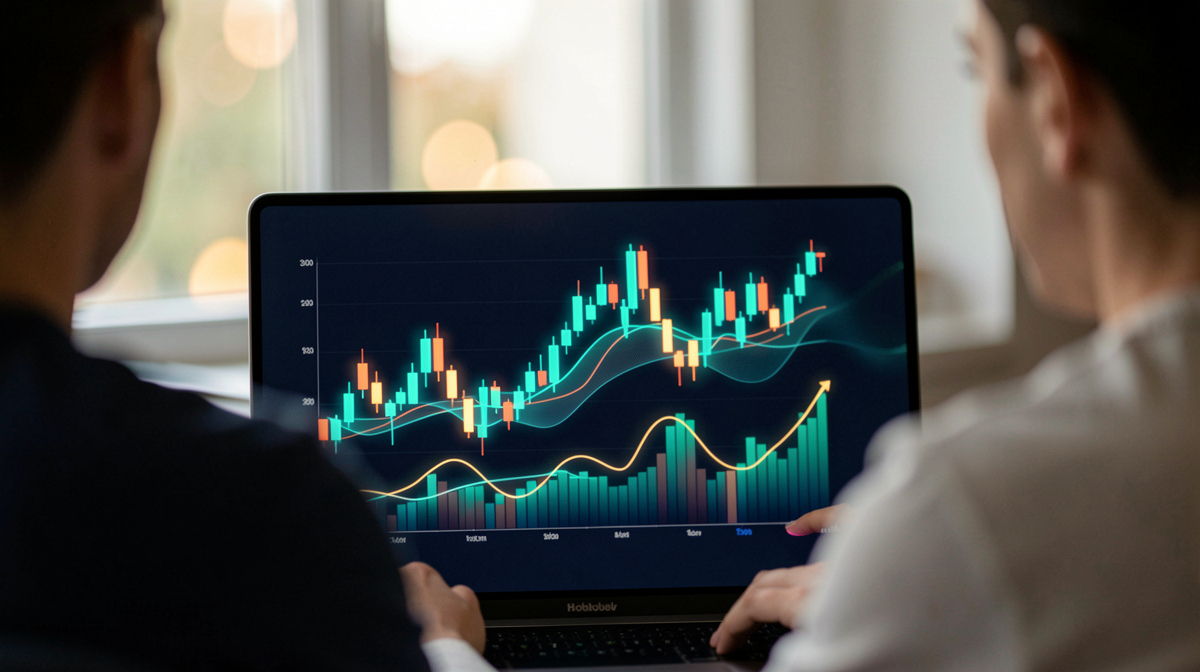
Traditional screeners filter for fundamentals; modern platforms filter for momentum. Here is how to use AI-driven tools to cut through the noise and find actionable signals in the current market volatility.
- AI screeners prioritize momentum and probability over static fundamental ratios.
- High-conviction signals require filtering for high-probability directional moves, not just low valuations.
- Combining global sector data with US index trends reduces blind spots in portfolio construction.
The Limitation of Traditional Fundamental Screeners
Most retail investors still rely on static filters: P/E ratios below a certain threshold, debt-to-equity limits, or dividend yield floors. These metrics are useful for long-term value investing, but they are dangerously slow in a market defined by rapid repricing and algorithmic flow. When the S&P 500 hovers near all-time highs while bond yields edge upward, a static screener might flag a high-yield utility stock as a "buy," missing the fact that the sector is being sold off due to rate sensitivity. The gap between "undervalued" and "going to rise" is where traditional tools fail.
This is why the search for the best stock screeners 2026 is shifting toward dynamic, predictive platforms. The goal is not to find the cheapest stock, but to identify stocks with a high probability of outperforming in the next trading cycle.
Tickers in focus
| Ticker | Company | Sector | Exchange |
|---|---|---|---|
| 1 | CK Hutchison Holdings | other | unknown |
| 101 | Hang Lung | real_estate | unknown |
| 1024 | Kuaishou Technology | telecom | unknown |
| 1038 | CK Infrastructure Holdings | utilities | unknown |
| 1044 | Hengan Group | consumer | unknown |
| 1055 | China Southern Airlines | industrials | unknown |
| 1061 | Essex Bio-Technology | health_care | unknown |
| 1066 | Shandong Weigao Group Medical Polymer | health_care | unknown |
| 1088 | China Shenhua Energy | energy | unknown |
| 1093 | CSPC Pharmaceutical | health_care | unknown |
| 1099 | Sinopharm Group | health_care | unknown |
| 1109 | China Resources Land | real_estate | unknown |
| 1113 | CK Asset Holdings | real_estate | unknown |
| 1171 | Yankuang Energy Group | energy | unknown |
| 1177 | Sino Biopharmaceutical | health_care | unknown |
| 12 | Henderson Land | real_estate | unknown |
Tools the pros use to research stocks — See recommended tools ›
Why AI Prediction Platforms Outperform Manual Filters
Machine learning models do not care about a company’s brand reputation or a CEO’s tone in an earnings call. They care about patterns. By ingesting vast datasets—including order flow, sentiment, and macroeconomic variables—AI tools can identify divergences between price action and fundamental reality. This allows for the automation of buy and sell signals that traditional software cannot generate.
- Speed: AI processes intraday data in milliseconds, whereas manual analysis takes hours.
- Objectivity: Algorithms remove emotional bias, such as fear during a dip or greed during a spike.
- Pattern Recognition: Models detect complex, non-linear relationships that human analysts rarely spot in real-time.
The result is a tool that functions less like a library and more like a radar, scanning the horizon for threats and opportunities simultaneously.
Analyzing Global Sector Data: A Case Study
To understand the utility of these tools, look at the breadth of data available on platforms like AI Stock Predictions. Recent scans show active AI price predictions across a diverse set of tickers, including CK Hutchison Holdings (1) and Henderson Land (12) in the real estate sector, and ICBC (1398) and AIA Group (1299) in financials.
Consider China Shenhua Energy (1088) and Yankuang Energy Group (1171). While traditional screeners might group these simply as "energy," an AI model distinguishes their specific risk profiles based on recent commodity price volatility and regulatory news. Similarly, Hua Hong Semiconductor (1347) and Shanghai Fudan Microelectronics (1385) are tagged as IT stocks, but their prediction trajectories may diverge sharply based on supply chain disruptions or domestic demand shifts. By tracking these specific tickers, investors can see how AI models assign different probabilities to similar assets, revealing nuanced alpha that a broad "tech sector" filter would obscure.
Navigating Market Volatility with Predictive Signals
The current market environment is characterized by conflicting signals. Recent headlines indicate that stock futures slipped after the Dow posted back-to-back weekly declines, yet the S&P 500 remains near historical highs. This disconnect is precisely where predictive tools shine. When the market is "sleeping" on a potential opportunity, as noted in recent coverage of Eli Lilly’s potential trillion-dollar opportunity, AI models can flag the divergence before it becomes consensus.
Furthermore, with Nvidia earnings approaching, volatility is expected to spike. Traditional tools offer no guidance on how to trade the post-earnings move. Predictive platforms, however, can estimate the probability of a gap-up versus a gap-down based on historical reaction patterns and current short interest. This allows traders to position themselves ahead of the event rather than reacting to the news.
The Role of Equal-Weight and Factor Exposure
A notable trend in 2026 is the leadership of the equal-weight S&P 500, with its flagship trade hitting $100 billion. This suggests that beta is shifting from mega-cap tech dominance to broader market participation. Traditional screeners are often biased toward large-cap liquidity, making them poor tools for finding alpha in mid-cap or small-cap stocks.
AI-driven screeners can be configured to factor in market-cap neutrality. By filtering for high-conviction signals in less-covered stocks, investors can capture returns that are not priced in by the largest funds. This is particularly relevant for sectors like healthcare, where tickers like Essex Bio-Technology (1061) and CSPC Pharmaceutical (1093) may offer distinct predictive opportunities compared to the broader index.
Integrating Macro Data into Technical Signals
The best stock analysis software 2026 does not operate in a vacuum. It integrates macroeconomic data directly into technical signals. For instance, if Treasury yields edge upward, the model might automatically down-weight predictions for long-duration growth stocks and up-weight predictions for short-duration value stocks.
This holistic approach addresses the "two big things" traders watch this week: bond yields and geopolitical risk. By correlating these macro factors with specific ticker predictions, the platform provides a context-aware signal. A "buy" signal for a consumer stock like Xtep (1368) is only valid if the macro environment supports consumer spending; otherwise, the AI model should suppress the signal. This layer of contextual filtering is what separates sophisticated predictive tools from simple momentum trackers.
Practical Implementation: From Signal to Execution
Using these tools requires a disciplined workflow. First, define your risk tolerance. High-conviction signals often come with higher volatility. Second, validate the signal against current news. If a headline suggests a regulatory crackdown on a specific sector, pause execution even if the AI probability is high. Third, automate where possible. Many platforms now allow for the automation of buy and sell signals, executing trades when specific probability thresholds are met.
The objective is to reduce manual work while increasing precision. By leveraging AI to scan thousands of tickers for high-probability moves, you free up your own time for higher-level strategy. The technology does not replace judgment, but it eliminates the fatigue that leads to poor decision-making.
Note: All predictions discussed are AI-generated estimates based on historical and real-time data. They are probabilistic in nature and do not guarantee future performance. Investors should always conduct their own due diligence.
Frequently asked questions
What is the best AI stock trading tool for beginners in 2026?
Start with platforms that offer transparent probability scores rather than opaque black-box recommendations. Look for tools that allow you to adjust the conviction threshold so you can start with high-probability, lower-risk signals before moving to more aggressive trades.
Do stock screeners work better than manual analysis?
For short-term trading and high-frequency opportunities, yes. Screeners scan the entire market in seconds, identifying patterns humans miss. For long-term value investing, manual analysis of fundamentals remains superior, but AI tools can speed up the initial screening process.
How accurate are AI stock predictions?
Accuracy varies by timeframe and market condition. In trending markets, AI models often outperform random chance by significant margins. In choppy, directionless markets, accuracy drops. Always treat predictions as probabilities, not certainties, and manage risk accordingly.
Can I automate buy and sell signals without trading full-time?
Yes. Most modern platforms allow you to set conditional orders based on AI signals. You can configure the system to alert you or execute trades automatically when a stock hits a specific prediction threshold, allowing you to manage a portfolio alongside a full-time job.
What is a high-conviction signal in stock trading?
A high-conviction signal is a prediction with a high probability of directional movement, usually accompanied by strong technical confirmation. It implies that the model sees a significant edge in the price action, warranting a larger position size or tighter stop-loss parameters.
Please note. AI Stock Predictions content is generated by artificial-intelligence and machine-learning models for educational and informational purposes only. It is NOT financial, investment or trading advice. Forecasts can be wrong. Always do your own research and consult a licensed financial advisor before making investment decisions. Investing involves risk, including possible loss of principal.