Tesla Stock Forecast 2026: Robotaxi Catalysts and Targets

AI forecast

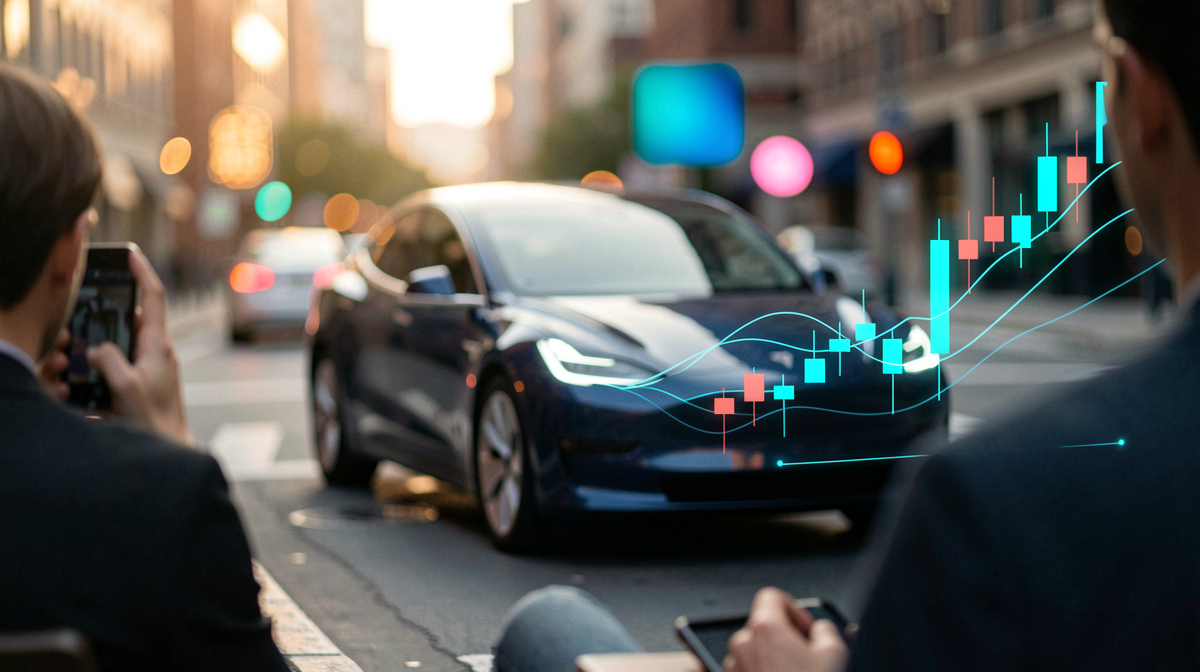
Robotaxi deployment is no longer a distant promise; it is the central variable for Tesla’s 2026 valuation. This analysis connects specific operational milestones to realistic price target adjustments.
- Robotaxi revenue in 2026 will likely remain negligible, but operational data will drive valuation re-rating.
- Price target revisions hinge on FSD v14+ performance metrics, not just vehicle deliveries.
- The investment case relies on Tesla’s ability to convert technical milestones into scalable, profitable services.
The Shift from Speculation to Operational Reality
For years, Tesla’s stock price has been driven by binary events: earnings surprises, Elon Musk’s social media activity, and macroeconomic shocks. As we enter 2026, the narrative is shifting. The market is increasingly pricing in the probability of successful autonomous operations rather than just car sales. The Tesla stock forecast 2026 is now defined by a new variable: the Robotaxi rollout. Investors are no longer asking if Tesla can build a robotaxi; they are asking how many miles it drives without intervention and what that translates to in earnings per share.
This transition changes the analytical framework. Traditional EV valuation models, which rely on unit volume and gross margin, are being supplemented by service-based metrics. The key question for any Tesla stock prediction 2026 is whether the company can decouple its valuation from volatile consumer auto demand and anchor it to recurring software and service revenue. The stakes are high because the potential upside of a successful autonomous fleet dwarfs the incremental gains from selling more Model Ys.
Tickers in focus
| Ticker | Company | Sector | Exchange |
|---|---|---|---|
| 1 | CK Hutchison Holdings | other | unknown |
| 101 | Hang Lung | real_estate | unknown |
| 1024 | Kuaishou Technology | telecom | unknown |
| 1038 | CK Infrastructure Holdings | utilities | unknown |
| 1044 | Hengan Group | consumer | unknown |
| 1055 | China Southern Airlines | industrials | unknown |
| 1061 | Essex Bio-Technology | health_care | unknown |
| 1066 | Shandong Weigao Group Medical Polymer | health_care | unknown |
| 1088 | China Shenhua Energy | energy | unknown |
| 1093 | CSPC Pharmaceutical | health_care | unknown |
| 1099 | Sinopharm Group | health_care | unknown |
| 1109 | China Resources Land | real_estate | unknown |
| 1113 | CK Asset Holdings | real_estate | unknown |
| 1171 | Yankuang Energy Group | energy | unknown |
| 1177 | Sino Biopharmaceutical | health_care | unknown |
| 12 | Henderson Land | real_estate | unknown |
Tools the pros use to research stocks — See recommended tools ›
Robotaxi Deployment Milestones and Valuation Triggers
To understand the robotaxi rollout impact, one must look at specific, verifiable milestones rather than vague timelines. Analysts are currently modeling three distinct phases for 2026:
- Phase 1: Limited Commercial Pilot. Small-scale, geofenced robotaxi services in Austin and San Francisco. The goal here is not revenue, but data. The market reacts to safety metrics: miles per intervention, accident rates, and customer satisfaction scores.
- Phase 2: Expanded Urban Coverage. Expansion to new cities (e.g., Los Angeles, Phoenix) and increased fleet size. This phase triggers scrutiny on unit economics. Investors look for the cost per mile and the revenue per ride.
- Phase 3: Scale-Up and Monetization. A significant jump in fleet size and ride frequency. This is where the Tesla price target outlook begins to diverge from consensus, as scalable revenue enters the model.
Each phase carries different risk profiles. Phase 1 is low-revenue, high-data. Phase 2 is moderate-revenue, high-legal/operational risk. Phase 3 is high-revenue, high-capital-expenditure. The current market consensus is that Tesla will complete Phase 1 in 2025 and begin Phase 2 in late 2025 or early 2026. Any delay in moving from Phase 1 to Phase 2 is the primary downside risk for the Tesla stock forecast 2026.
Price Target Revisions: What Analysts Are Watching
Wall Street has been adjusting its models throughout 2025, and these adjustments will continue into 2026. The key inputs for these revisions are not just the number of cars on the road, but the quality of the autonomous driving data.
The FSD v14+ Factor
The release and subsequent performance of Full Self-Driving (FSD) version 14 and beyond is the technical backbone of the robotaxi strategy. If FSD v14+ demonstrates significantly lower intervention rates in urban environments, it validates the scalability thesis. Conversely, if intervention rates remain high, the timeline for Phase 3 slides out, compressing the valuation multiple. Analysts are closely watching Tesla’s quarterly updates on miles driven by FSD vehicles and the proportion of miles driven without human intervention.
Regulatory and Legal Headwinds
The rollout is not just a technical challenge; it is a regulatory one. State-by-state permitting, insurance frameworks, and liability laws create a fragmented market. A Tesla stock prediction 2026 that ignores the pace of regulatory approval is incomplete. One analyst noted that a single major accident or a significant regulatory setback in a key state could force a re-rating of the entire autonomous segment. The market is currently giving Tesla some slack for operational hiccups, but that slack is finite.
The Macro Context: Valuation Pressures and Sector Rotation
Tesla does not exist in a vacuum. The broader market environment in late 2025 and early 2026 is characterized by rising bond yields and valuation compression in growth stocks. Recent headlines indicate that rising Treasury yields are rattling tech-heavy indices, with the S&P 500 and Nasdaq facing headwinds from discount-rate pressures.
This macro backdrop is critical for interpreting the Tesla stock forecast 2026. Tesla, as a high-duration growth asset, is sensitive to interest rate moves. If the Fed maintains a higher-for-longer stance, the present value of future robotaxi cash flows is discounted more heavily. This means that even positive operational news may be muted by macro headwinds. Conversely, if bond yields stabilize or decline, Tesla’s valuation multiple could expand on the back of robotaxi progress, creating a double bottom. Investors should monitor the interplay between Tesla-specific catalysts and the broader fixed-rate environment.
Platform Data Context: Comparing Tesla to Global Tech and Financials
While Tesla is the focus, it is useful to situate its forecast within the broader global equity landscape. Our platform tracks numerous international tickers, providing a comparative context for risk and return.
Consider the dispersion across sectors. Tickers like 1347 (Hua Hong Semiconductor) and 1385 (Shanghai Fudan Microelectronics) represent the hardware and chip supply chain that underpins autonomous vehicles, albeit primarily in the Chinese ecosystem. Their performance reflects the global tech cycle. Meanwhile, financial names like 1288 (Agricultural Bank of China) and 1299 (AIA Group) offer a contrast in risk profiles: lower volatility, higher dividend yield, but less exposure to the autonomous driving revolution.
For a diversified portfolio, the robotaxi rollout impact on Tesla represents a concentrated bet on a specific technological outcome. It is not a sector-wide trade. While energy names like 1088 (China Shenhua Energy) provide stability, and consumer names like 1044 (Hengan Group) offer steady cash flows, Tesla offers asymmetric upside tied to a binary technological success. The platform data underscores that Tesla’s forecast is not driven by general market beta, but by idiosyncratic operational milestones. Investors should treat it as a satellite position, sized accordingly, rather than a core holding.
The Investment Case: Grounded in Data, Not Hype
The honest investment case for Tesla in 2026 is neither bullish nor bearish; it is conditional. It is conditional on the company’s ability to deliver specific, verifiable operational milestones.
- Bull Case: FSD v14+ achieves low intervention rates, enabling Phase 2 expansion. Robotaxi revenue begins to materialize, even if modestly, proving the unit economics. The market re-rates the stock from an auto company to a tech/services company, with a higher multiple.
- Bear Case: Intervention rates remain high, regulatory hurdles slow expansion, and capital expenditure requirements exceed internal cash generation. The stock trades as a speculative tech asset, with wide volatility and limited downside protection.
The Tesla price target outlook will reflect this conditionality. Expect wide dispersion among analysts. Those who weight the operational success highly will carry targets well above consensus; those who emphasize the execution risk will carry targets in line with or below historical auto-sector multiples. The prudent approach is to monitor the quarterly operational updates and adjust exposure based on the evidence, not the narrative.
A Note on Predictions and Uncertainty
It is essential to state clearly that all forecasts, including those on AI Stock Predictions, are AI-generated and not guaranteed. They are models built on historical data, stated assumptions, and probabilistic reasoning. They do not account for unforeseen black swan events, sudden regulatory changes, or shifts in management strategy. Investors should use these forecasts as one input among many, not as a substitute for their own due diligence. The future of autonomous driving is uncertain, and the Tesla stock forecast 2026 should be treated as a scenario analysis, not a prophecy.
Frequently asked questions
Is Tesla stock a buy in 2026?
It depends on your risk tolerance and your view of the robotaxi timeline. If you believe Tesla can successfully scale autonomous rides in 2026, the upside potential is significant. If you are skeptical of the technical or regulatory feasibility, the valuation risk is high. Most analysts suggest waiting for clearer operational data before making a large position.
What is the biggest risk to the Tesla robotaxi rollout?
The biggest risk is operational: high intervention rates or safety incidents that delay expansion. A single major accident could trigger regulatory pauses in key markets, pushing the timeline out by years and compressing the valuation. Technical failure is more damaging than competitive pressure.
How does rising interest rates affect Tesla's stock price?
As a growth stock, Tesla is sensitive to discount rates. Rising bond yields reduce the present value of its future cash flows, including potential robotaxi revenue. This macro headwind can offset positive company-specific news, making the stock more volatile in a rising-rate environment.
What metrics should I watch to gauge robotaxi progress?
Focus on miles driven by FSD vehicles, the percentage of miles without human intervention, and the number of cities with active robotaxi services. These operational metrics are more indicative of progress than vehicle delivery numbers, which reflect the legacy auto business.
Is the Tesla stock forecast 2026 reliable?
No forecast is reliable in the sense of being certain. The Tesla stock forecast 2026 is a probabilistic model based on current data and assumptions. It should be used to understand potential outcomes, not to predict specific price movements. Always conduct your own research and consider your personal financial situation.
Please note. AI Stock Predictions content is generated by artificial-intelligence and machine-learning models for educational and informational purposes only. It is NOT financial, investment or trading advice. Forecasts can be wrong. Always do your own research and consult a licensed financial advisor before making investment decisions. Investing involves risk, including possible loss of principal.